
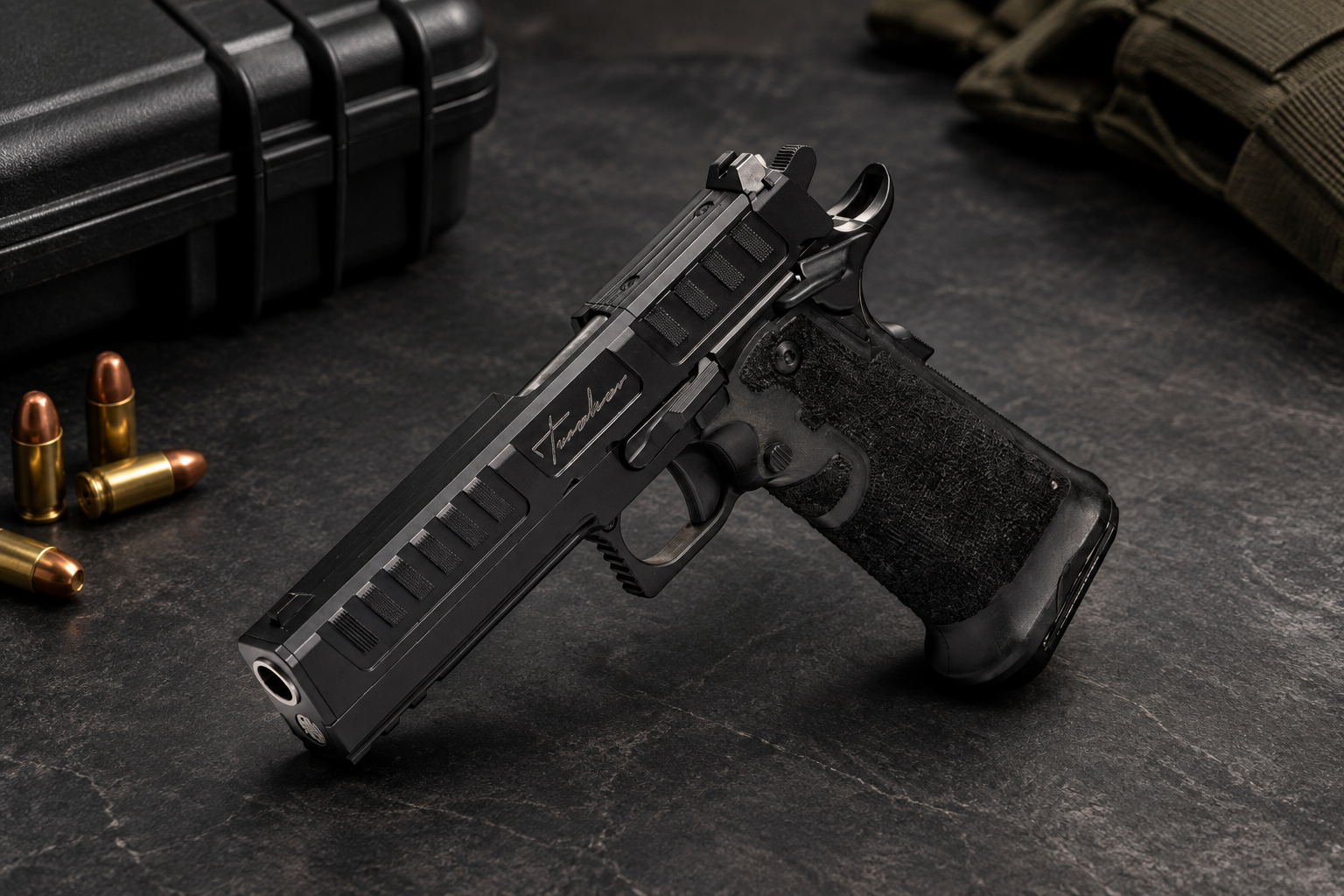
In 1991 a Texas gunsmith set out to solve a problem that had defeated the 1911 for eighty years: how to fit a double-stack magazine into a pistol without turning the grip into something most hands cannot hold.
The answer was not a better grip. It was to stop making the frame and the grip the same part.
That idea, patented in the early 1990s, produced the platform now known as the 2011 and three decades later it is the dominant architecture in practical shooting competition, with Springfield Armory, Kimber and now SIG Sauer all building versions of it. This is how a custom-shop fix for IPSC shooters became a category.
First, what a 2011 actually is
A 2011 is not simply a 1911 with a fat magazine. This distinction gets muddled constantly, and it matters.
The defining feature is two-piece modular construction: a metal upper frame carrying the action, bolted to a separate, swappable grip module that houses a double-stack magazine. The grip module can be steel, aluminium or polymer. The frame can be steel, stainless, titanium or aluminium. They are manufactured independently and mechanically interlock.
Widebody one-piece double-stack 1911s exist and predate the 2011 — Para-Ordnance built them, Caspian made frames for them. Those are high-capacity 1911s. They are not 2011s, because the grip is not a separate component.
The capacity gain is substantial. A standard single-stack 1911 in .45 ACP holds seven rounds. A 2011 in the same calibre can hold around fourteen. Achieving that meant redesigning the trigger, the magazine catch and the mainspring housing, because the wider magazine passes straight through the space the trigger bow occupies.
The inheritance: what the 1911 contributed
The 2011 kept the parts of Browning’s design that competitors valued and changed the part they did not.
The M1911, adopted by the US Army on 29 March 1911, uses a short-recoil locked-breech action and a single-action trigger. That trigger is the reason the design survived. It moves straight back, breaks predictably, and resets over a very short distance — all of which matter when the difference between placings is measured in hundredths of a second. The thin grip and low bore axis were the other attractions, though the bore-axis advantage is something competitors consistently report rather than something published testing has pinned down.
What the 1911 could not offer was capacity. Seven rounds is a lot of standing reloads on a stage designed around thirty.
1991 to 1994: building the modular frame
Virgil Tripp had been building custom 1911s for competitive shooters since 1982, and in 1987 designed the industry’s first EDM-cut 1911 hammers and sears before founding Tripp Research. In 1991 he began development on a modular 1911 frame. In 1993, engineer Sandy Strayer joined him, taking equal ownership and co-patent rights, and the company became Strayer-Tripp International, or STI.
Their US patent 5,293,708, filed on 8 July 1992 and granted on 15 March 1994, states the design goal in the designers’ own words:
“It is another feature of this invention to provide a novel frame/handgrip assembly for increased round capacity, autoloading handguns wherein the handgrip portion thereof is of substantially the same external thickness dimension as compared with the Government Model 1911 A1 handgun and yet has an internal magazine receptacle of greater than standard width.”
That sentence is the whole platform. Same grip thickness as a service 1911, wider magazine inside it.
The patent is candid about why earlier attempts failed. Prior high-capacity designs forced a choice: accept a bulky grip, or drop to a smaller calibre. Aluminium frames saved weight but introduced structural risk. Splitting the frame from the grip removed the trade-off, because each component could then be optimised, and manufactured, on its own terms.
The 1994 split, and why two companies matter
In June 1994, months after the patent was granted, Strayer left STI and founded Strayer-Voigt Inc. with professional shooter and gunsmith Michael Voigt, trading as Infinity Firearms. Tripp returned to Tripp Research and to magazine design.
The result was two parallel lineages from one patent. STI moved toward series production, particularly after Dave Skinner bought the company in 1997. SVI went the other way, into highly customised, made-to-order competition pistols — complete guns still started above four thousand dollars as of 2019.
Voigt is the clearest link between the platform and the podium. He held three individual IPSC world championship titles and seven world team titles, took fourteen USPSA multigun titles, and served as president of USPSA from 2000 to 2012.
A note on the many other champions associated with 2011-pattern pistols: the title records are easy to verify and the specific pistol used for each title usually is not. Todd Jarrett won the 1996 IPSC World Championship in Open Division and a long list of USPSA titles across the 1990s and 2000s. Max Michel has thirteen USPSA national championships and seven Steel Challenge world speed shooting titles, and STI was his first sponsor when he was fifteen. Both are genuinely part of this story. Neither should be described as having won a particular title on a particular gun without a source that says so.
Why competition adopted it
The platform spread because it answered several problems at once.
Capacity removed reloads from stages, which removes both time and the risk of fumbling under pressure.
Mass, placed usefully. Steel and tungsten-loaded grip modules put weight low and forward, which reduces muzzle rise between shots. Recoil that the gun absorbs is recoil the shooter does not have to correct for.
Grip modularity, the patent’s stated purpose, lets a shooter fit the gun to their hand by swapping a component rather than by reshaping a frame. Material, texture and circumference all become choices.
Trigger geometry inherited intact. The redesigned trigger bow preserves 1911 feel around a double-stack magazine, which is the trick that makes the whole thing worth doing.
Tunability. A 1911 parts ecosystem, plus a separately replaceable grip module, plus a gunsmithing tradition four decades deep.
Those advantages map onto specific divisions. In IPSC, the platform is at home in Open, the only division permitting optics and compensators, and in Standard, where the pistol must fit a 225 by 150 by 45 mm box and widebody 2011s chambered for major-scoring calibres became standard equipment. Classic division is modelled on single-stack. IPSC added Production Optics in 2025. In USPSA the relevant divisions include Limited, Limited Optics, Open and Single Stack, and the platform also appears throughout Steel Challenge.
The 2019 US Marshals adoption is generally treated as the moment the platform stopped being purely a competition object. The rename to Staccato followed in May 2020, with the Staccato product brand having appeared the year before.
What has happened since is a straightforward consequence: once a design is proven and its original patent has aged out, the majors arrive. Springfield Armory and Kimber entered the 2011 market, which pulled entry prices down from the custom tier. SIG Sauer’s P211 GT5 and GT4, announced in January 2026 with steel frames and P320-compatible magazines, mark the point at which one of the largest handgun manufacturers in the world decided the category was worth building for.
A design that began as one gunsmith’s answer to an IPSC problem is now something a shooter can buy from four or five major manufacturers.
Where India sits
This is the part an Indian reader needs, and it requires care.
Competitive shooting in India runs through the National Rifle Association of India, founded on 17 April 1951 and affiliated to the ISSF. That affiliation shapes everything downstream: the disciplines run here are ISSF-pattern events, and NRAI’s own import rules specify .22 LR for 25m Sport Pistol, Standard Pistol, Rapid Fire Pistol and 50m Pistol, and .32 calibre, 7.62 to 9.65mm, for 25m Centre-Fire Pistol. Revolvers in .327, .357 and .38 Special are importable by international-level shooters on a restricted cycle.
Two consequences follow. First, the calibres in which 2011 pistols are normally built for competition elsewhere — 9mm, .38 Super and .40 S&W among them — are not calibres an ordinary Indian civilian applicant can expect to be licensed for, which is why the configuration offered to Indian civilians is .45 ACP and why even that is described as case-by-case. Second, India does not appear in IPSC’s published list of regions, so the divisions where the platform excels are not run domestically. Practical shooting as the rest of the world plays it does not currently have an Indian competitive home.
On the quantitative side, the Arms (Amendment) Act 2019, notified in February 2020, reduced the general civilian limit from three firearms to two, while raising the exempted ceiling for renowned shooters to twelve (eight for a single event, ten for two, twelve for more) and increasing annual ammunition allowances to 5,000 rounds of .22 LR and 2,000 rounds for other pistols and revolvers.
Whether a 2011-pattern pistol can be licensed to any given Indian applicant depends on the calibre, the licence category and the applicant’s circumstances, and it is a question for a licensing authority rather than an article. GEAM Guns, which builds a 2011-pattern pistol in Noida aimed at experienced USPSA and IPSC shooters, appears to be the only Indian maker of a competition-oriented pistol; the other Indian pistols in production are ordnance-factory products built for the forces rather than for sport.
Common questions
What is the difference between a 1911 and a 2011?
A 1911 has a one-piece frame with an integral grip and a single-stack magazine. A 2011 uses two pieces: a metal upper frame bolted to a separate, swappable grip module, which allows a double-stack magazine without widening the grip beyond service dimensions. A widebody one-piece double-stack 1911 is not a 2011.
Who invented the 2011?
Sandy Strayer and Virgil Tripp, under US patent 5,293,708, filed in July 1992 and granted in March 1994. Tripp had begun the modular frame project in 1991; Strayer joined in 1993.
Why is it called a 2011?
It reads as a next-generation designation for the 1911 — the platform it derives from and mechanically extends.
Why do competition shooters prefer it?
Capacity, weight distribution that reduces muzzle rise, a grip that can be fitted to the hand by swapping a module, an inherited 1911 trigger, and deep tunability.
Is STI the same company as Staccato?
Yes. STI Firearms renamed itself Staccato on 26 May 2020, having introduced Staccato as a product brand the previous year.
Can I own a 2011 pistol in India?
It depends on calibre, licence category and your individual circumstances. The chamberings used competitively elsewhere are largely not licensable to Indian civilians, and there is no domestic IPSC-style discipline. Ask your district licensing authority about your own eligibility before anything else.
What to read next
The 2011’s history is really the history of one constraint being removed, and the interesting question it raises is what the platform inherited from Browning that nobody has yet improved on. If you want to follow the thread backwards, the .45 ACP cartridge and the original M1911 are where it starts.
If you are an Indian shooter trying to work out what is actually available and licensable here, GEAM Guns’ team in Noida, founded by two competitive shooters including a 2003 World Cup and Asian Clay Championship medallist, can explain what Indian manufacturing and licensing rules permit before you invest time in a platform you may not be able to hold.
This article is general information about firearm design history and competitive shooting. It is not legal advice, and it is not guidance on the use of any firearm. Licensing in India is governed by the Arms Act 1959 and the Arms Rules 2016, administered at the discretion of the licensing authority, and depends on the applicant’s category and circumstances. Rules differ by state and change over time; the position here reflects sources available in August 2026. Confirm your own eligibility with your district licensing authority and, where appropriate, a qualified lawyer.