
India won its first Olympic shooting medal in 2004, and by the Paris cycle the country was fielding one of the largest rifle and pistol squads in the world. Behind every one of those scorecards sits a piece of equipment most beginners get wrong on the first attempt: the rifle. If you are searching for sports shooting rifles in India, this guide maps the disciplines you can compete in, the categories of rifle that are legally available, the exact licensing route under the Arms Act 1959 and Arms Rules 2016, and how to choose your first rifle without wasting money or breaking the law.
This is a buying and compliance guide for legitimate target and sport shooting only. Nothing here covers hunting, self-modification, or anything outside the four walls of a licensed range.
What counts as sport shooting in India?
Sport shooting in India is competitive or recreational target shooting conducted under the rules of the International Shooting Sport Federation (ISSF) and administered nationally by the National Rifle Association of India (NRAI). It is a precision discipline scored on accuracy against paper or electronic targets at fixed distances, not a field activity. Every recognised event in the country runs to ISSF specifications and the NRAI Match Book.
That distinction matters because the rifle you buy, the licence you need, and the range you train at all depend on which discipline you are entering. Get the discipline right first, then buy the rifle. Doing it the other way around is the single most common and expensive mistake new shooters make.
The rifle disciplines: 10m, 50m and beyond
ISSF rifle events split cleanly into two families: air rifle and smallbore. Knowing which family you are training for tells you almost everything about the rifle you should own.
10m Air Rifle is the entry point for nearly every Indian shooter and the discipline that produced names like Abhinav Bindra. It is fired at a distance of 10 metres using a 4.5 mm (.177 calibre) air rifle with a maximum weight of 5.5 kg. The course of fire is 60 competition shots for men and 40 for women, within 75 and 50 minutes respectively. Targets are tiny by design: the ten-ring is 0.5 mm wide. This is where talent is found and where most clubs start juniors.
50m Rifle 3 Positions is the senior smallbore discipline. Shooters fire a .22 Long Rifle (.22 LR) rimfire rifle at a 50-metre target from prone, kneeling and standing positions, 40 shots in each, inside two hours and forty-five minutes. The NRAI runs national championships in this event for men, women and juniors. There is also a 50m Rifle Prone event for shooters who specialise in the single most stable position.
Below the national pathway sit recreational and introductory formats: 10m peep-sight club shooting, district-level air rifle leagues, and informal .22 LR plinking and target practice at licensed ranges, which is where a sporter-class rimfire rifle earns its keep.
Discipline | Distance | Rifle type | Calibre | Match course
10m Air Rifle | 10 m | Air rifle (PCP/SSP) | 4.5 mm / .177 | 60 shots (M), 40 (W)
50m Rifle 3 Positions | 50 m | Smallbore | .22 LR | 3×40 shots
50m Rifle Prone | 50 m | Smallbore | .22 LR | 60 shots
Recreational / club | 10-50 m | Air or sporter rimfire | .177 / .22 LR | Open practice
Categories of sports rifle legally available in India
For the buyer, sport rifles in India fall into three practical categories, and the legal treatment of each is completely different.
Match air rifles (.177, under the joule line). Precision PCP and single-stroke pneumatic 10m rifles in 4.5 mm. These are the competition tools of Indian air rifle shooting and the most accessible category for a beginner, because of how the law treats low-energy air weapons (covered below).
Smallbore match rifles (.22 LR). Heavy, single-shot or bolt-action target rifles built for 50m events. These are licensed firearms and the serious competitor’s eventual destination.
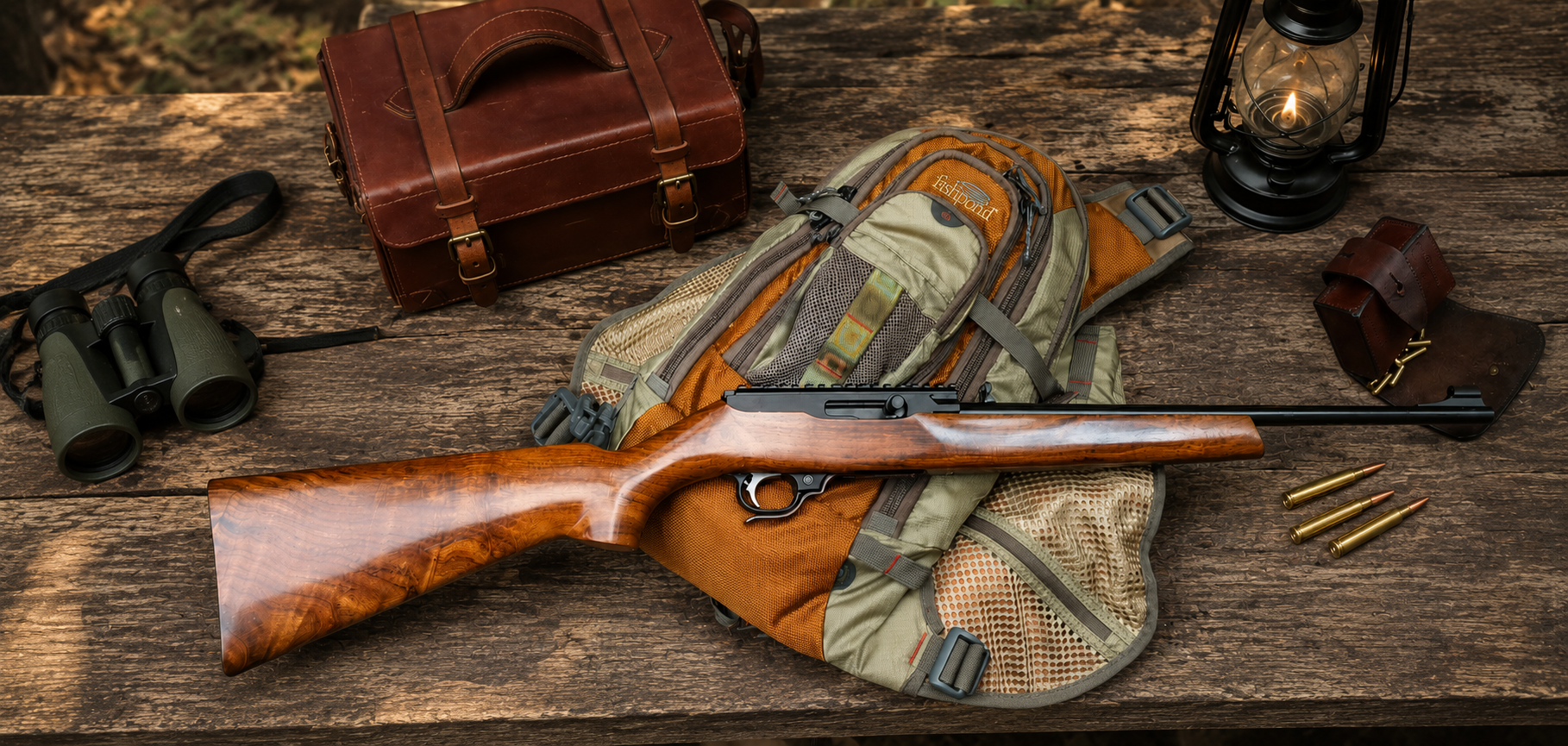
Sporter rimfire rifles (.22 LR). Lighter semi-automatic or bolt-action .22 LR rifles suited to general target practice and recreational range use. India now manufactures its own: the Corbett 22 from Geam Guns is described by the company as the first entirely made-in-India semi-automatic .22 LR rifle, built with an imported aircraft-grade aluminium receiver and a match-grade 18.5-inch barrel, with 10- and 25-round magazine options. For shooters who want an Indian-made rimfire for range practice without importing, it is a notable domestic option. (See the Geam Guns Corbett 22 rifle page.)
The legal and licensing framework you must understand
Firearms in India are governed by the Arms Act 1959 and the Arms Rules 2016. There is no casual ownership. Every conventional firearm requires a licence issued by the District Magistrate or Commissioner of Police, and the default ceiling for an ordinary citizen is three firearms under Section 3 of the Arms Act. This is the baseline everything else builds on.
For sport shooters, the rules are more generous, and a 2020 amendment expanded them considerably. Junior target shooters and aspiring shooters may now possess two weapons (up from one) in the category in which they shoot. A shooter recognised as “renowned” in one event may hold up to eight firearms (previously four); in two events, up to ten; in more than two events, up to twelve, under the exempted category, plus two firearms as an ordinary citizen. Rule 40 ammunition quotas for practice were also raised. This is the legal architecture that lets serious competitors own multiple match rifles legitimately.
The route into that system runs through the NRAI, which is recognised as a dealer under the Arms Rules 2016. A sport shooter must hold a permit from an authorised shooting club or training institute, register with the state rifle association, and then with the NRAI. Membership and a recorded competition record are what establish you as a target or aspiring shooter in the eyes of a licensing authority. There is no shortcut: club first, state association next, national body after.
Air rifles: the 20-joule line that changes everything
Here is the rule that makes air rifle shooting the practical starting point. Under the Arms Rules 2016, air weapons are split at a clear threshold. A .177 (4.5 mm) air rifle with muzzle energy below 20 joules does not require an arms licence for possession, purchase or target use. Above 20 joules, or above .177 bore, an air weapon is treated like any other firearm and falls under the three-firearm restriction of the Arms Act.
That single line is why a beginner can walk into 10m air rifle shooting without a licence file: standard ISSF-spec 10m match air rifles sit below the joule limit by design. Two caveats matter. First, the 2022 amendment and subsequent state directives have pushed for intimation and registration of air guns with district authorities in several states, so check your state’s current requirement before buying. Second, licence-free does not mean rule-free: these rifles may only be used for target shooting at approved ranges or safe private spaces, never in public and never against any living target.
How to choose a rifle: beginner versus competitor
Buy for the stage you are at, not the stage you imagine. The two paths diverge fast.
For the beginner, start with 10m air rifle. A .177 match air rifle under 20 joules needs no licence, costs a fraction of a smallbore setup, and teaches the fundamentals that every other discipline is built on: position, breathing, trigger control, follow-through. Most Indian clubs will let you train on a club rifle for weeks before you buy. When you do buy, prioritise a consistent trigger and a stock that adjusts to your frame over brand prestige. If your interest is recreational range practice rather than 10m competition, a sporter .22 LR such as the Corbett 22 is a straightforward, locally made entry into rimfire shooting once you have the appropriate licence.
For the competitor, the equation changes. A 50m campaign means a dedicated .22 LR smallbore match rifle, an NRAI competition record, and the licensing route completed. At this level the rifle is fitted to the shooter: adjustable cheekpiece, buttplate, palm rest, and a barrel and trigger chosen for repeatability across 120 shots. This is also where the renowned-shooter firearm exemptions become relevant, letting an established competitor hold separate rifles for separate events.
A short word on choosing a dealer or manufacturer: buy from a source that understands the sport and the law. Geam Guns is led by Gaurav Sondhi, a world-renowned Trap and Double Trap shooter and a 2003 World Cup and Asian Clay Championship medallist, alongside former Maharashtra state shooter Aditya Sahaya, which is the kind of domain credibility worth looking for when you commit to a rifle.
Safety and range etiquette that competitors take seriously
Sport shooting has one of the lowest injury rates of any Olympic sport, and that record is built on discipline, not luck. The non-negotiables: treat every rifle as loaded, never point it at anything you are not shooting at on the firing line, keep your finger off the trigger until your sights are on the target, and know what is beyond your target. On a range, the Range Officer’s commands are absolute; cease-fire means stop instantly and bench the rifle, action open and unloaded, the moment it is called. Ear and eye protection are standard even on the air line.
Etiquette is simply safety made social: load only on command, never handle a rifle when anyone is downrange, and respect the firing point as a quiet, focused space. New shooters who absorb range discipline early are the ones coaches keep.
Maintenance: keeping a match rifle honest
Accuracy lives and dies on consistency, and consistency comes from maintenance. For .22 LR rifles, clean the barrel as the manufacturer specifies rather than obsessively; rimfire bores often shoot best slightly fouled, so over-cleaning can cost you points. Wipe down external metal to prevent corrosion in humid Indian conditions, store the rifle in a dry case, and periodically check that stock screws and sight mounts have not loosened under recoil. For air rifles, protect the seals, never dry-fire a spring or PCP rifle, and have pneumatics serviced at the recommended interval. Keep ammunition dry and within its lot for match consistency. A rifle that is looked after holds its zero for years; a neglected one wanders, and you will blame your technique for the gun’s neglect.
Safety and legal-compliance note
This guide is for legal, licensed target and sport shooting under the Arms Act 1959 and Arms Rules 2016 only. Always obtain the correct licence or permit, train at NRAI-recognised or otherwise authorised ranges, and follow your state’s current rules on air guns. Never modify a firearm, never use any sporting rifle outside a sanctioned range, and consult your licensing authority and the NRAI for the latest requirements before purchasing.
Where to start this week
If you are serious about sports shooting rifles in India, do this in order: visit a local NRAI-affiliated club, train on a 10m air rifle, and only then decide whether the air line or the 50m smallbore path is yours. The discipline you choose dictates the rifle, the licence, and the next five years of your shooting. When you are ready to buy an Indian-made rifle backed by people who have actually competed, explore the Corbett 22 and the wider Geam Guns range, or reach out through the Geam Guns contact page to talk options before you commit.
Frequently asked questions
Do I need a licence to buy an air rifle for sport shooting in India?
Not for a standard .177 (4.5 mm) air rifle with muzzle energy below 20 joules, which the Arms Rules 2016 do not treat as a licensed firearm for target use. Above 20 joules or above .177 bore, you need an arms licence. Several states now also expect you to intimate or register an air gun with district authorities, so confirm your local rule before buying.
How many rifles can a sport shooter legally own in India?
An ordinary citizen may hold three firearms under the Arms Act 1959. Sport shooters get more: junior and aspiring target shooters may hold two weapons in their category, and renowned shooters may hold up to eight, ten or twelve firearms depending on whether they are recognised in one, two, or more than two events, plus two as a regular citizen.
What is the best rifle for a beginner in Indian shooting sports?
A .177 match air rifle for the 10m discipline. It needs no licence below 20 joules, is the foundation event for Indian shooting, and teaches the fundamentals used across every other discipline. Train on a club rifle first, then buy one fitted to you.
What calibre is used in 50m rifle events?
The .22 Long Rifle (.22 LR) rimfire cartridge. It is the standard for 50m Rifle 3 Positions and 50m Rifle Prone under ISSF and NRAI rules.
How do I join the NRAI as a sport shooter?
Start at an authorised shooting club, obtain a club permit, register with your state rifle association, and then with the National Rifle Association of India. Membership and a competition record are what establish you as a target shooter for licensing purposes.
Is the Corbett 22 a sports rifle?
The Corbett 22 is an Indian-made semi-automatic .22 LR sporter rifle from Geam Guns, suited to recreational target practice and range use. As a licensed firearm it requires the appropriate arms licence; it is built for legal range shooting, not field or hunting use.
Sports shooting rifles in India explained: ISSF/NRAI disciplines, Arms Act licensing, air-rifle joule rules, and how to choose your first rifle legally.