
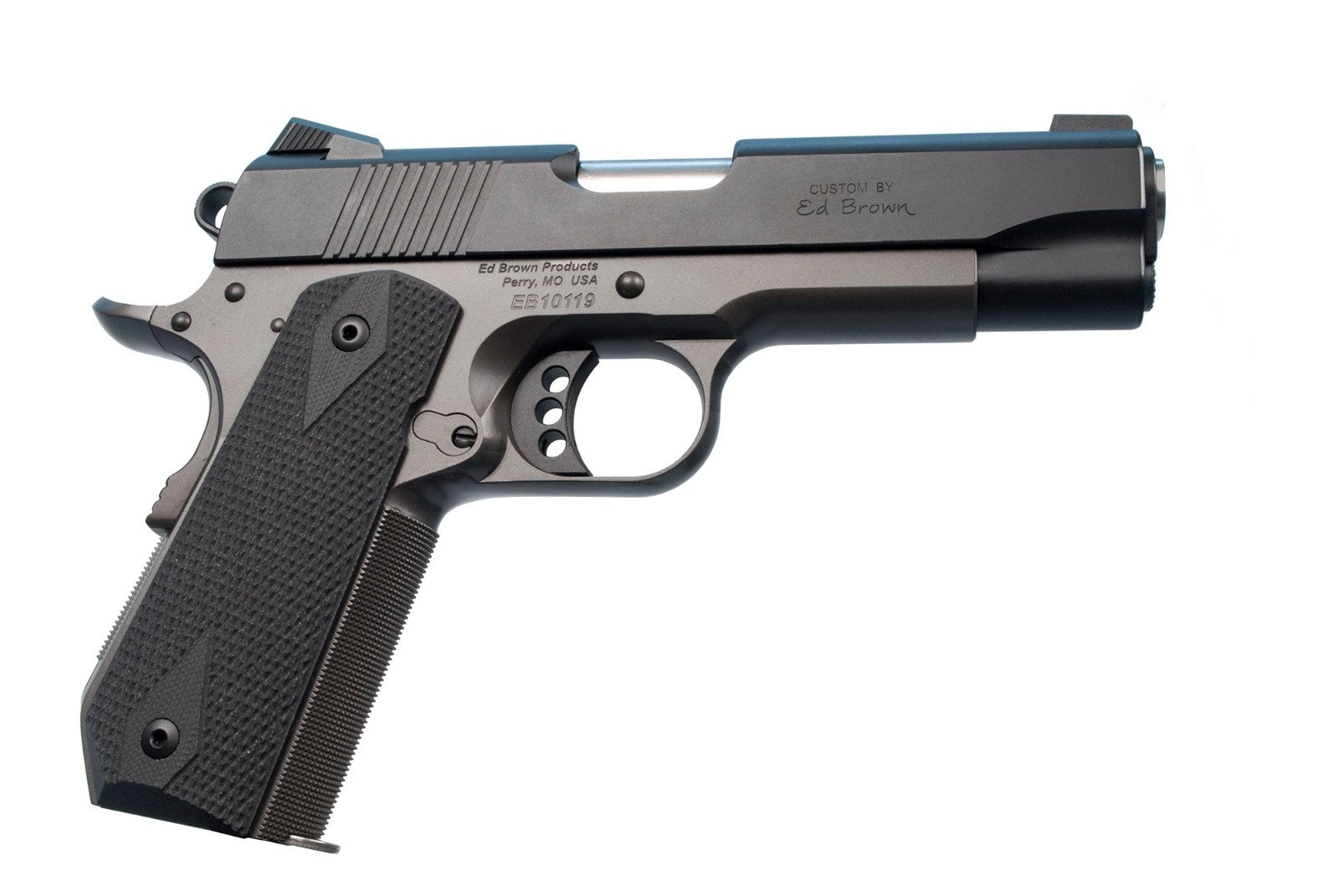
The .45 ACP exists because of a report written in 1904. The US Army, dissatisfied with the .38 Long Colt its officers had carried through the Philippine campaigns, commissioned what became known as the Thompson-LaGarde tests, and the conclusion was that a service handgun needed a considerably larger bullet. John Browning, working with Colt, designed the cartridge that answered that brief. It has been in continuous production for over 120 years.
That longevity is the interesting part. Cartridges introduced in the same era mostly disappeared. This one is still made, still shot competitively, and still argued about — and understanding why requires looking at what Browning actually built rather than at the mythology that has accumulated around it.
One thing to establish at the outset, because it governs everything an Indian reader needs to know: the .45 ACP is not a calibre an ordinary civilian in India can expect to license. The detail sits further down, and it is more nuanced than most pages on this subject admit. If that is the question you came for, skip to the section on Indian law.
What the .45 ACP actually is
.45 ACP stands for .45 Automatic Colt Pistol. It is a straight-walled, rimless, centre-fire pistol cartridge designed for autoloading actions.
The specifications, as published by SAAMI:
Bullet diameter .452 in (11.5 mm)
Case length .898 in
Overall length 1.275 in
Maximum pressure 21,000 psi (140 MPa)
Standard service load 230 gr full metal jacket at roughly 830 ft/s
Two of those numbers matter more than the others. The 21,000 psi ceiling is low — modern 9x19mm runs to roughly 35,000 psi — and the 230-grain bullet is heavy for a handgun. That combination is the whole design philosophy: move a large, heavy projectile at modest velocity and modest pressure.
Browning’s original 1905 loading used a 200-grain bullet at about 900 ft/s. The 230-grain load that became standard arrived with formal adoption of the cartridge alongside the Colt M1911 on 29 March 1911, as the “Cal. .45 Automatic Pistol Ball Cartridge, Model of 1911”.
Why Browning designed it that way
Low pressure and heavy bullets are an engineering choice with consequences that run through the whole gun.
A low-pressure cartridge permits a simpler, less highly stressed action, and it produces a recoil impulse that is long and comparatively slow rather than sharp. Shooters describe this as a push rather than a snap. That is not a subjective quirk — it follows from moving more mass at less speed for the same rearward momentum.
The cost is size. A .45 case is fat, and case diameter sets the width of the magazine. A single-stack 1911 in .45 ACP holds seven or eight rounds where a comparable frame in 9mm holds more. Every double-stack .45 design in the century since has been an attempt to get around that geometry, and none of them has made the cartridge narrow.
There is a detail here that surprises people, and it matters specifically for target shooting. Light .45 target loadings can produce less felt recoil than standard 9mm, because the pressure is lower and the impulse is spread over more time. This is precisely why sustained-fire precision shooters have favoured the cartridge for decades. It is a comfortable round to shoot accurately in slow fire, which is a very different property from the one it is usually credited with.
.45 ACP and 9mm, as an engineering comparison
Both cartridges are well over a century old and both are still in front-line service somewhere, which should tell you neither is obsolete.
| Feature | .45 ACP | 9×19mm |
|---|---|---|
| Bullet diameter | 11.5 mm | 9 mm |
| Typical bullet weight | 230 gr | 115–147 gr |
| Typical velocity | ~830 ft/s | ~1,100–1,250 ft/s |
| SAAMI max pressure | 21,000 psi | 35,000 psi |
| Recoil character | Longer, slower impulse | Sharper, faster impulse |
| Capacity, similar frame | Lower | Higher |
| Year introduced | 1904–05 | 1902 |
The honest summary is that they solve the same problem with opposite priorities. The .45 puts its budget into projectile mass and diameter; the 9mm puts its budget into velocity, capacity and lower recoil per unit of energy. Which is preferable depends entirely on what you are doing, and for target shooting the answer usually comes down to what the rulebook of your discipline permits.
Where .45 ACP is actually shot in competition
Internationally, the cartridge has two established homes.
NRA Precision Pistol, historically called Bullseye, includes a dedicated .45 Calibre stage. The rules are specific: any .45 calibre semi-automatic pistol or revolver, barrel not exceeding ten inches. This is slow, deliberate, one-handed target shooting at 25 and 50 yards, and it is the discipline that best suits the cartridge’s characteristics.
USPSA Single Stack Division is built around Government-model 1911 pistols, with .45 ACP scoring as a Major calibre and an eight-round magazine limit. IPSC’s nearest equivalent is Classic Division.
Beyond that, the cartridge appears in steel and action-shooting divisions where major-calibre scoring is an advantage, and it retains a following among shooters who simply like it.
What Indian law actually says, and what it does not
This is the section that matters most, and it is where almost every page on this topic overreaches. What follows is limited to what can be verified.
The Arms Act 1959 does not classify firearms by calibre at all. Its definition of “prohibited arms” under section 2(1)(i) covers automatic weapons — firearms that keep discharging while the trigger is held — along with artillery, anti-aircraft and anti-tank weapons and noxious-gas devices. Nothing in the Act names a pistol cartridge.
The categorisation that governs civilian licensing sits instead in Schedule I of the Arms Rules 2016, read with Rule 3, which sorts arms into restricted and permissible categories. The Ministry of Home Affairs, in its published policy on granting arms licences to individuals, describes the practical split this way: automatic and semi-automatic arms fall under Prohibited Bore, and non-automatic or bolt-action arms under Non-Prohibited Bore.
You will find confident calibre-by-calibre lists all over the internet. We are not going to reproduce one, for a straightforward reason: the freely available government sources do not reproduce the Schedule I table, the lists in circulation trace back to secondary commentary rather than to a gazette notification, and they contradict each other on at least one common calibre. A list that might be wrong is worse than no list on a subject where being wrong has legal consequences.
What is verifiable and useful:
Who can hold a Prohibited Bore licence. Since 1987, PB licences are granted by the Central Government, not by states, and MHA policy limits them to four narrow classes: residents of terrorist-affected areas under grave and imminent threat; government officials targeted by reason of office; MPs, MLAs and private persons closely associated with anti-terrorist work; and family members of such persons. Non-Prohibited Bore licences are granted by state authorities on police threat assessment.
There is no sport-shooting route to .45 in India. The sports quota under the Arms Rules 2016 covers .22 LR, centre-fire rifle up to 8mm, revolver and pistol, and shotgun up to 12 bore. The National Rifle Association of India is affiliated to the ISSF, and ISSF’s only large-calibre pistol event, 25m Centre-Fire Pistol, permits calibres between 7.62mm and 9.65mm. At 11.43mm, .45 ACP is outside that range. The cartridge that actually dominates that event is the .32 S&W Long wadcutter. India is also not a listed IPSC region, so the divisions where .45 is competitive are not run here.
How many firearms, and for how long. Section 3(2) of the Act, as amended by the Arms (Amendment) Act 2019, permits a person to hold two firearms. Many articles still say one, which was the figure in the 2019 Bill and not in the Act as passed. Licence validity was raised to five years by the same amendment. Recognised shooters sit under a separate exempted regime: MHA’s February 2020 notification raised the ceiling for renowned shooters to twelve firearms and annual ammunition to 5,000 rounds of .22 LR.
And the point on which no blog should be your authority. Whether a specific .45 ACP pistol can be licensed to a specific applicant is a question for the licensing authority in your district and, if the sums and stakes justify it, for a lawyer. GEAM Guns’ published position is that “the .45 ACP is allowed only on a special case-by-case basis as an NPB firearm”; other commentary treats the calibre as prohibited bore outright. That disagreement between sources is precisely why you should ask a licensing authority rather than infer an answer from anything you read online.
The Delhi High Court put the underlying principle plainly in 2023: an arms licence “is a creation of the statute and the licensing authority is vested with the discretion whether to grant or not grant such a licence.”
The collector’s and student’s case for the cartridge
If the licensing position rules out ownership for most Indian readers, the cartridge is still worth understanding, and for two reasons that have nothing to do with acquiring one.
The first is that the M1911 is one of the most consequential mechanical designs of the twentieth century. Its short-recoil locked-breech action, its single-action trigger geometry and its grip angle are still being copied in 2026. Reading the 1911 teaches you most of what you need to know about how autoloading pistols work, and the .45 ACP is inseparable from that design.
The second is that engineering literacy transfers. Understanding why a low-pressure, large-diameter cartridge behaves as it does — why recoil impulse is not the same thing as energy, why case diameter dictates magazine width, why a heavier bullet at lower velocity can be easier to shoot well — makes you a better judge of any firearm you are legally able to own or shoot. That engineering-first way of reading a cartridge is closer to how competitive shooting actually thinks than the capability arguments that dominate popular discussion.
FAQs
Is a .45 pistol legal in India?
It depends on the licence category and on your specific circumstances, and this is not a question to settle from an article. The categorisation of arms sits in Schedule I of the Arms Rules 2016; Prohibited Bore licences are granted only by the Central Government to four narrow classes of applicant. Ask your district licensing authority about your own case.
Can a sport shooter in India get a .45?
Not through the sports route. The sports quota covers .22 LR, centre-fire rifle up to 8mm, revolver and pistol, and shotgun up to 12 bore, and the ISSF disciplines the NRAI runs cap centre-fire pistol at 9.65mm. There is no Indian competitive discipline in which .45 ACP is shot.
How many firearms can a licensed person own in India?
Two, under section 3(2) of the Arms Act as amended in 2019. Recognised competitive shooters are treated separately and may hold more.
Is .45 ACP better than 9mm?
They are different engineering answers to the same question. The .45 moves a heavier, wider bullet slowly at low pressure; the 9mm moves a lighter bullet faster at higher pressure with more capacity in the same frame. For target shooting the deciding factor is normally what your discipline’s rules permit, not the cartridge itself.
Why is the recoil described as a push rather than a snap?
Because the same rearward momentum delivered by a heavier bullet at lower velocity, at lower chamber pressure, is spread over a longer period. Lightly loaded .45 target ammunition can feel milder than standard 9mm for this reason.
Who invented the .45 ACP?
John Moses Browning, working with Colt, in 1904, with production from 1905. It was adopted alongside the M1911 pistol on 29 March 1911.
Where to take this next
If you are researching the .45 ACP as a shooter or a student of firearm design, the useful next step is to understand the platform built around it rather than the cartridge in isolation: the 1911, and the modular double-stack designs that descend from it. For the specifications of a .45 ACP pistol built in India, the .45 pistol guide on this site covers barrel lengths, capacities and configurations.
If you are researching it as a prospective owner in India, the useful next step is a conversation with your district licensing authority about which categories you are eligible for, before you spend time choosing a firearm. GEAM Guns‘ team in Noida can talk you through what Indian law permits a manufacturer to build and sell, and what the licensing route for any given category actually involves.
This article is general information about firearm history and engineering. It is not legal advice. Firearm licensing in India is governed by the Arms Act 1959 and the Arms Rules 2016, is administered at the discretion of the licensing authority, and turns on the applicant’s individual circumstances and category of licence. Requirements differ by state and by licence type and change over time; the position described here reflects sources available in August 2026. Confirm your own position with your district licensing authority and, where appropriate, a qualified lawyer before acting. This article does not address, and should not be read as guidance on, the use of any firearm.