
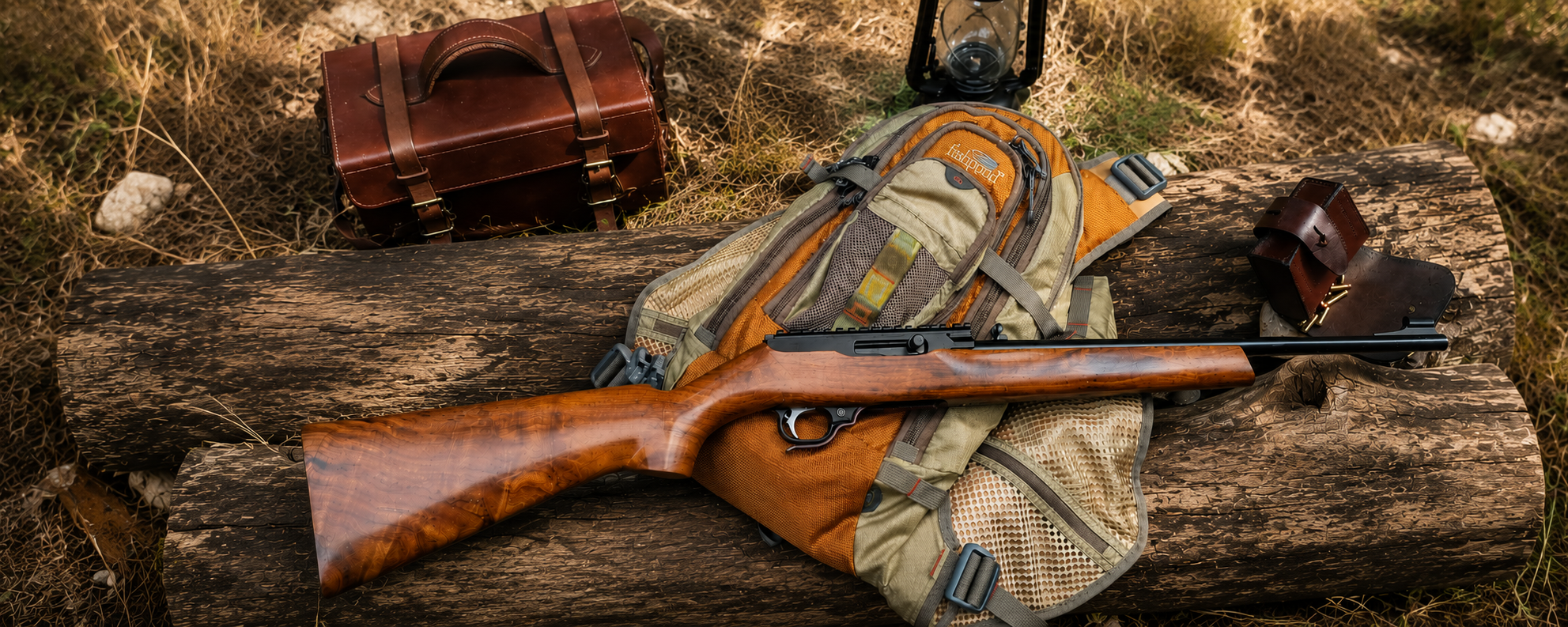
Most “best air rifle in India” lists copy American gear reviews and never tell you the one number that decides whether your purchase is legal: 20 joules. Get that wrong and a target rifle becomes a licensed firearm under the Arms Rules, 2016. So this guide does it the other way round. We start with the law, then match air-rifle types, calibres and build quality to honest target-shooting use, the way a beginner in Noida or Nagpur actually buys.
A quick framing first. Geam Guns is the firearms and precision-engineering arm of Ghaziabad Engines & Machines Pvt. Ltd., a Sector 63, Noida manufacturer with 40-plus years in mechanical engineering and rare in-house rifle-barrel capability. It is led by Gaurav Sondhi, a Trap and Double Trap shooter who medalled at the 2003 World Cup and the 2003 Asian Clay Championship, and Aditya Sahaya, a former Maharashtra state-level shooter. That sporting pedigree is why this guide treats an air rifle as a precision instrument for the range, not a toy and not a weapon.
The law decides what “best” even means
For most Indian buyers the best air rifle is the most accurate one you can own without a licence. The Arms Rules, 2016 split air weapons into two categories in Schedule I. Category III(f)(ii) covers air rifles and air guns with muzzle energy below 20 joules (15 ft-lb) and a bore of 0.177 inch (4.5 mm) or less. These are exempt from licensing. Category III(f)(i) covers anything exceeding 20 joules or 0.177 inch bore, and those are treated like any other firearm: they need a licence and count within your three-firearm limit under Section 3 of the Arms Act, 1959 (Source: MHA Arms Rules 2016 FAQ, Q.20-Q.23).
In plain terms: a .177 calibre air rifle producing under 20 joules is your licence-free lane. Step up to .22 calibre, or to a high-power .177 that crosses 20 joules, and you are now in licensed-firearm territory.
One more thing the gear blogs skip. Even a licence-exempt air rifle must be sold through an Air Weapon Dealer holding a Form VIII-A licence, and that dealer must record your identity and residence proof at the point of sale (MHA FAQ, Q.23). If a seller does not ask for ID, that is a red flag about the seller, not a convenience.
Air rifle types: how the power is made
Four power-plants dominate the Indian market, and each suits a different buyer.
Spring-piston (break-barrel). You cock the barrel, compressing a spring; releasing it drives a piston that fires the pellet. No gas, no battery, no tank. It is the most affordable and the most forgiving to own, which is why it is the default beginner recommendation across Indian retailers. The trade-off is a sharp recoil “jump” that punishes sloppy hold, so it actually teaches good fundamentals.
Gas-piston (gas-ram / nitro-piston). Same break-barrel idea, but the spring is replaced by a sealed gas strut. Smoother cocking, less vibration, better cold-weather and long-storage behaviour. It costs a little more than a comparable spring gun and is a sensible upgrade for someone who shoots weekly.
PCP (pre-charged pneumatic). A built-in reservoir is filled from a hand pump, scuba tank or compressor, giving many consistent, low-recoil shots per fill. PCPs are the most accurate and the easiest to shoot well, which is why competition shooters favour them, but Indian retail PCPs commonly run from roughly Rs 35,000 to over Rs 1.5 lakh and need fill kit. Important: many high-end PCPs are tuned well past 20 joules, which pushes them into the licensed Category III(f)(i) bracket. Check the rated muzzle energy before you assume “no licence.”
CO2. A 12g cartridge or larger bottle supplies the push. Pleasant, recoil-free plinking and great for casual practice, but velocity drops as the cartridge empties and in cold weather, so it is less suited to precise outdoor target work.
.177 vs .22: pick by purpose, not by macho
.177 (4.5 mm) is the calibre that keeps you in the licence-exempt category, and it is the right choice for target shooting and skill-building. It is lighter, flatter-shooting and cheaper to feed, so you can shoot more pellets per hundred rupees and build muscle memory faster. Indian retailers and trainers near-unanimously tell beginners to start here.
.22 (5.5 mm) hits harder at the cost of a more looping trajectory. But understand the legal consequence: any .22 air rifle sits outside the exempt 0.177 bore and therefore requires a licence in India. For a hobbyist who simply wants tight groups at the range, .22 adds cost and paperwork without adding accuracy. Our position is unambiguous: for target practice, start with a quality .177 under 20 joules.
What to look for in a target air rifle
Accuracy you can repeat. Look for a match-grade or choked barrel, a crisp two-stage trigger and a rifle weight you can hold steady, usually 2.3 to 3.2 kg. A heavier rifle is harder to carry but easier to shoot well, which is the right trade-off for the range.
Build quality. Steel internals, a properly bedded action and a stock that fits you matter more than a flashy scope. Geam Guns’ own engineering ethos is a useful yardstick here: the firm machines from aircraft-grade aluminium alloy and firearm-specific medium-carbon steels chosen for fatigue and creep resistance. You want that mindset, durable materials over marketing, in whatever you buy.
Honest power rating, in writing. Insist on the manufacturer’s stated muzzle energy in joules and bore in mm. This single spec decides your legal category. Treat a missing or vague figure as a reason to walk away.
Consistency over headline velocity. A rifle that delivers the same velocity shot after shot will out-group a “faster” rifle that varies. For PCPs that means a regulated action; for spring guns it means a quality seal and a settled tune.
Air rifle categories sold in India: a responsible round-up
Rather than push any single high-power model, here is how the market segments by category and intended target use. We deliberately describe by spec band, not by “most powerful.”
Air rifle category | Typical calibre | Best for | India legal status (general) | Indicative price band
Entry break-barrel (spring) | .177, sub-20 J | Beginners, range target practice | Licence-exempt III(f)(ii) | Rs 5,000-Rs 15,000
Gas-piston break-barrel | .177, sub-20 J | Weekly hobby shooters | Licence-exempt III(f)(ii) | Rs 10,000-Rs 25,000
Entry/mid PCP | .177, check J rating | Accuracy-focused target shooters | Exempt only if under 20 J; else licensed | Rs 35,000-Rs 1.5 lakh+
CO2 rifle/pistol | .177, sub-20 J | Casual indoor plinking | Licence-exempt III(f)(ii) | Rs 6,000-Rs 20,000
High-power .22 / 20 J+ .177 | .22 or high .177 | Licensed sport / permitted vermin control | Licensed III(f)(i) | Varies; via Form VIII dealer
Prices are indicative and vary by dealer, region and import duty. The legal column is the one that should drive your shortlist first.
Who can buy, and how to buy safely
For licence-exempt .177 sub-20-joule air rifles, you buy from a Form VIII-A Air Weapon Dealer who records your identity and residence proof; in practice most retailers expect an adult buyer with valid ID. There is a separate, important provision for young shooters: under Rule 36 of the Arms Rules, 2016, a person aged 12 to 21 may use permissible-category arms strictly for training, and only in the immediate presence and under the direct supervision of an adult instructor or licensee. That is the lawful, structured way a school-age target shooter learns.
If you want a higher-power or .22 air rifle, you are applying for a firearm licence: an application to your District Magistrate or Commissioner of Police, police background verification, a mental-health and fitness certificate, a safe-storage undertaking, and purchase through a Form VIII dealer. Licensed sport-shooting arms may be used only for practice and competition at recognised clubs and ranges (MHA FAQ, Q.17).
A note on hunting, because buyers ask. General hunting of protected wildlife is prohibited under the Wild Life (Protection) Act, 1972. Only Schedule V “vermin” species, and species specifically declared vermin by the competent authority for a limited area and time, may lawfully be controlled, and a high-power air rifle for that purpose falls under licensing. If your interest is genuine pest control where the law permits it, get the permit first and the right licensed equipment second. This guide does not endorse using a licence-exempt range rifle on wildlife.
Range and storage safety: the part that keeps it legal and alive
Treat every air rifle as loaded. Keep the muzzle pointed downrange, finger off the trigger until your sights are on a safe backstop, and never shoot toward roads, homes or anywhere a pellet can travel beyond your control. A pellet trap and a solid backstop are not optional extras for backyard practice; they are the difference between a hobby and a hazard.
Store the rifle unloaded, ideally in a locked cabinet, with pellets stored separately and out of reach of children. The same Arms Rules culture of “safe use and storage” that governs licensed firearms is good practice for air rifles too. Eye protection for everyone on the line is the cheapest insurance you will ever buy.
The honest recommendation
If you are a beginner buying your first air rifle in India for target practice, buy a well-made .177 spring-piston or gas-piston rifle rated under 20 joules, from a licensed Form VIII-A dealer, and spend the money you saved on calibre-chasing on a pellet trap, eye protection and a thousand quality pellets instead. Accuracy is a skill you train, not a spec you purchase. Step up to a regulated PCP once your fundamentals are solid, and to a licensed .22 only when a club or a lawful permit genuinely requires it.
Geam Guns brings four decades of precision engineering and championship-level shooting experience to the Indian market. To talk through legal, sport-focused options or to find an authorised dealer, contact the Geam Guns team or visit a listed dealer near you, and shoot safe, shoot legal.
Frequently Asked Questions
Which air rifle is best for beginners in India?
A .177 calibre break-barrel (spring-piston or gas-piston) rated under 20 joules. It is licence-exempt, affordable (roughly Rs 5,000-Rs 25,000), low-maintenance and teaches good shooting fundamentals through its honest recoil.
Do I need a licence to buy an air rifle in India?
Not for a .177 air rifle with muzzle energy below 20 joules, which is the exempt Category III(f)(ii) under the Arms Rules, 2016. Anything above 20 joules or in .22 (or larger) bore requires a firearm licence. Even exempt rifles must be bought from a Form VIII-A Air Weapon Dealer who records your ID.
Is .177 or .22 better for target shooting?
.177 for target practice. It is flatter-shooting, cheaper to feed, and crucially stays inside India’s licence-exempt category. .22 hits harder but requires a licence and adds no accuracy advantage for range work.
What is the most powerful air rifle I can legally own without a licence in India?
The legal ceiling is muzzle energy just under 20 joules in 0.177 bore. There is no licence-free “more powerful” option; crossing 20 joules moves the rifle into the licensed firearm category regardless of how it is marketed.
Can I use an air rifle for hunting or pest control in India?
General hunting is banned under the Wild Life (Protection) Act, 1972. Only declared vermin species, in permitted areas and periods, may be controlled, and that use falls under firearm licensing. Get the permit and licensed equipment first; a licence-exempt range rifle is not for wildlife.
Can a minor use an air rifle in India?
Under Rule 36 of the Arms Rules, 2016, a person aged 12 to 21 may use permissible-category arms only for training and only under the direct, immediate supervision of an adult instructor or licensee.
Important legal and safety note
This article is general information about lawful, sport-focused air-rifle ownership in India, not legal advice. The Arms Act, 1959, the Arms Rules, 2016, the Wild Life (Protection) Act, 1972 and individual state regulations govern purchase, possession and use, and rules can change. Always verify current requirements with your licensing authority and buy only through a licensed dealer. Geam Guns supports only legal, safe and responsible shooting for target, sport and lawfully permitted use.